The Proportion Project Study 08 · The Journal
+91 83693 81345

The Journal

Vol. 01Twelve essays on men's formal trousersThe Proportion Project · Options Mall

Long-form research on the history, fit and styling of formal pants — written to be read slowly, and returned to whenever you are choosing, fitting or styling a pair.

01HistoryApprox. 5 min read

The evolution of men's formal pants

From knee breeches to slim tailoring and back to pleats: a short history of how the formal trouser found its shape — and why it keeps changing.

From breeches to trousers

Until the late eighteenth century, fashionable European men wore knee breeches with stockings. Long trousers existed, but they were associated with working men, sailors and soldiers. Over the early nineteenth century that association changed. Full-length trousers — at first close-fitting and often strapped under the foot — moved into polite dress, and by the middle of the century they had replaced breeches for everyday wear.

The change was significant because it created the long, uninterrupted line from waist to floor that still defines menswear. Everything since has been a refinement of that line.

The crease and the turn-up

By the late nineteenth and early twentieth centuries, two details had become fixtures. The pressed front crease gave each leg a sharp vertical and became a sign of a well-kept trouser. The turn-up, or cuff, added weight at the hem and became common on less formal trousers. Belts gradually replaced braces as the usual way of holding trousers up, and belt loops became standard.

Volume, then restraint

The twentieth century swung between fullness and slimness. Mid-century tailoring favoured high waists, pleated fronts and generous legs. Later decades brought narrower, flat-fronted trousers, then a return to fuller, pleated cuts, and later still a long period of slim, low-rise tailoring.

Today: choice

The contemporary moment is defined less by one silhouette than by choice. Slim, tailored, straight and relaxed shapes coexist; pleats have returned alongside flat fronts; rises vary from mid to high. What remains constant is the importance of proportion — the balance between waist, leg and hem that the formal trouser has been negotiating for two centuries.
02FitApprox. 5 min read

The anatomy of a well-fitted trouser

Five landmarks, read from the waistband down, that separate a trouser that fits from one that merely closes.

1 · The waistband

A well-fitted waistband sits level all the way round, closes without strain and stays where it is without a belt. If the back gapes when you stand, or the front folds over when you sit, the waist is wrong — and no amount of tailoring lower down will fix the overall look.

2 · The pockets

Side pockets are the most honest fit indicator on any trouser. When the hip is right, they lie closed. When the hip is too tight, they open like small wings. Check them standing, in a mirror, with nothing in them.

3 · The rise and seat

The rise is the distance from the crotch seam to the waistband. Together with the seat, it determines comfort when sitting and how smoothly the trouser falls at the back. Horizontal pulls mean too tight; loose folds beneath the seat mean too much cloth.

4 · The crease

On a well-fitted trouser, the front crease runs straight down the centre of the leg and lands over the centre of the shoe. A crease that drifts inward or outward signals that the trouser is twisting — often because of a fit problem at the seat or thigh.

5 · The hem

Finally, the hem. It should be level, should frame the shoe and should create exactly the break you intend. Length is the easiest alteration to make, and the most often neglected.

Read top to bottom, these five landmarks give a quick and reliable verdict. For the full zone-by-zone method, see Fit Studies.

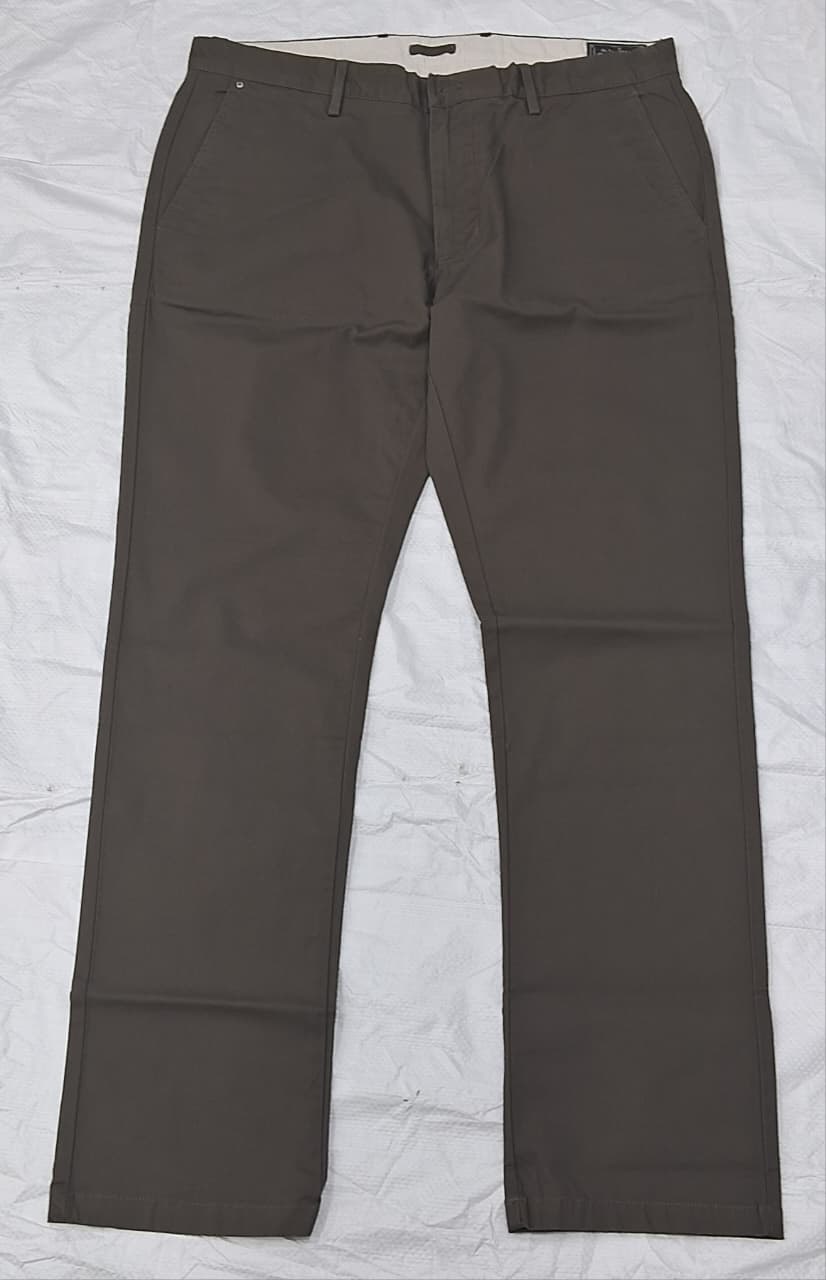
Olive-brown men's formal trousers laid flat, annotated with five fit landmarks
J-02 — Landmarks: 1 waistband · 2 pocket · 3 rise & seat · 4 crease · 5 hem.
03SilhouetteApprox. 4 min read

Understanding trouser silhouettes

A silhouette is a drawing made by cloth. Learning to read it is the first step to choosing well.

When we describe a trouser as slim, tailored, straight or relaxed, we are describing its silhouette — the outline it draws from the waist to the hem. That outline is set by three variables: how much room the trouser leaves through the seat and thigh, where it begins to narrow, and how wide it is at the opening.

Slim and tailored

Slim trousers keep all three variables tight, producing a long, narrow line. Tailored trousers follow the body at the seat and taper more gently from the knee. Both suit contemporary, close-fitting jackets and sleek shoes, and both depend on accurate sizing.

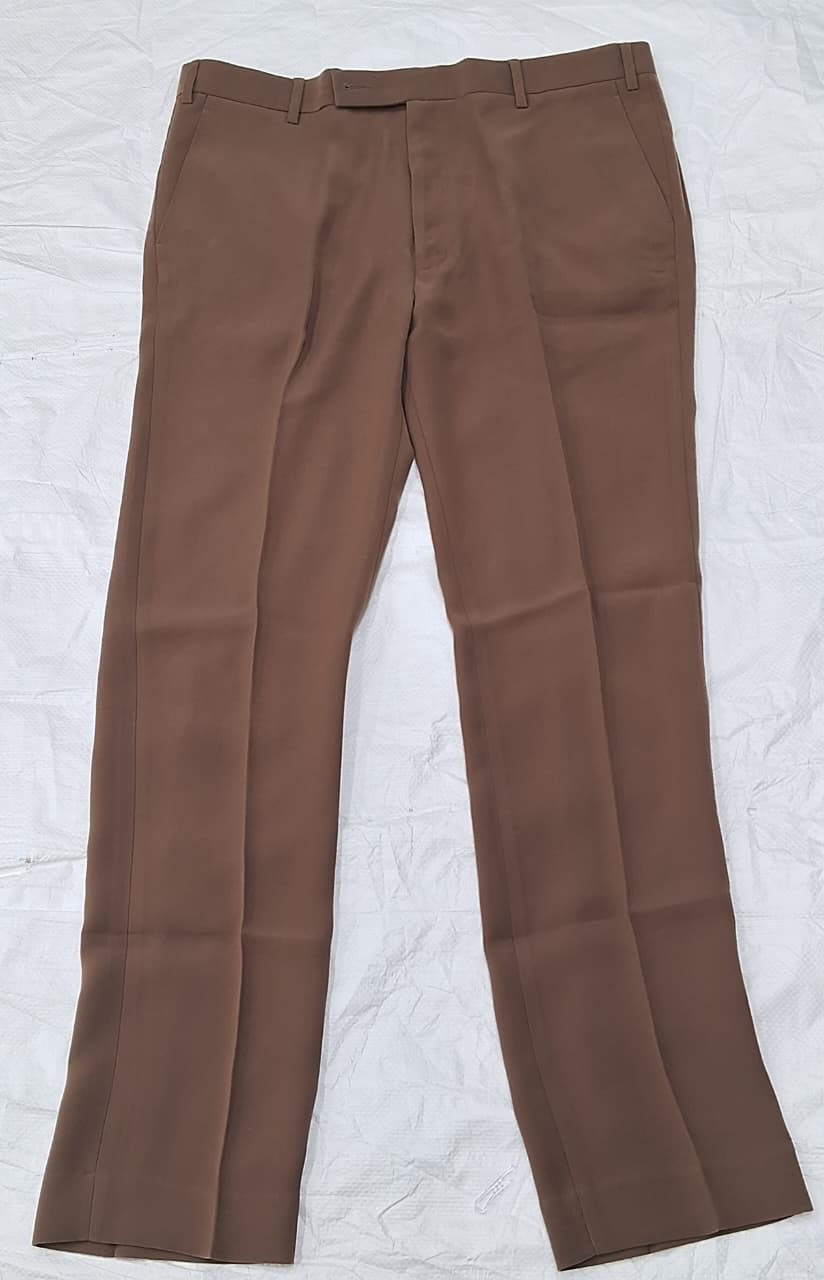
Rust brown men's formal trousers laid flat showing a gently tapered silhouette
J-03 — Rust brown: the taper from thigh to hem is the silhouette.

Straight and regular

Straight trousers hold the width of the knee all the way to the hem. Regular trousers add comfortable room through the seat and thigh. Both read steadier and more traditional, and both balance longer jackets and heavier shoes.

Relaxed and pleated

Relaxed silhouettes are generous throughout and often pleated. They have returned to contemporary menswear, usually with a higher rise and a precisely fitted waist so that the volume looks intentional rather than accidental.

Choosing a silhouette

Choose a silhouette in relation to your build, your jacket and your shoes. A slender frame looks sharp in slim cuts but can be overwhelmed by relaxed ones; a broader frame is often balanced by straight legs. Above all, choose a silhouette that you can wear at the right length.

Two ways to build the front of a trouser, each with its own logic. Neither is old-fashioned; each suits different bodies and outfits.

A pleat is not decoration. It is stored room, released when you sit and folded away when you stand.

What a pleat does

A pleat is a fold of cloth stitched into the waistband. It adds fabric over the hip and thigh, which gives comfort when seated and a softer, fuller drape when standing. Single pleats add a modest amount of room; double pleats add more. The inner pleat usually flows directly into the front crease, so the eye reads the fold and the crease as a continuous line.

What a flat front does

A flat-front trouser has no folds at the waist. The front panel is smooth, which looks clean, minimal and slim. Flat fronts dominated menswear for many years because they suit low and mid rises, slim legs and short jackets.

Which to choose

  • Choose flat-front for slim and tailored silhouettes, fitted shirts, shorter jackets and a modern, streamlined look.
  • Choose a single pleat for a little extra comfort without visible volume — a good everyday compromise.
  • Choose double pleats for straight or wider legs, higher rises, soft tailoring and knitwear.

The fit condition

Pleats only work when the trouser fits at the waist and hip. If either is tight, the pleats are pulled open and the front looks strained. A flat front, by contrast, shows every fold if it is too loose. In both cases, the right size is the precondition for the right look.

05ProportionApprox. 4 min read

Why trouser length matters

The final centimetres of a trouser change the proportion of the whole figure. Get them right and everything above looks better.

Length is the most visible fit decision and the one most often left to chance. Trousers that are too long pool on the shoe, add heavy horizontal folds at the ankle and make the leg look shorter. Trousers that are too short expose the sock, interrupt the line and can look like an accident rather than a choice.

Length and silhouette

The right length depends on the leg opening. A narrow opening cannot absorb extra length — it bunches. Slim and tapered trousers therefore look best with little or no break. Straight and wider legs can carry a slight or half break gracefully, because the fabric has somewhere to go.

Length and shoes

Always judge length in the shoes you will wear. A sleek loafer and a heavier derby sit at different heights and catch the hem differently. Many tailors cut the hem very slightly longer at the back than at the front, so it covers more of the heel while staying clean over the instep.

Length and occasion

Formal and traditional settings suit a slight to half break; contemporary office dressing tends towards a slight break or none; smart casual allows the cleanest, shortest lengths. Whatever you choose, make it deliberate.

06FitApprox. 4 min read

The importance of waist and seat fit

The top of the trouser decides how the rest of it hangs. If the waist and seat are wrong, nothing below can be right.

The waist is the anchor

A trouser hangs from its waistband. If the waist is too large, the trouser drops, the crotch sinks and the legs gather extra length at the hem. If it is too small, the waistband rolls, the fly strains and the pockets pull open. A well-fitted waist sits level, closes without effort and holds the trouser in place on its own.

The seat shapes the back view

Most people never see their own back view, but everyone else does. A seat that is too tight produces horizontal pull lines and makes pockets gape; a seat that is too loose produces vertical folds and a sagging look beneath. The goal is fabric that follows the body smoothly and then falls cleanly from the back of the thigh.

The rise connects the two

The rise links waist and seat. A rise that is too short for the body pulls the waistband down at the back when sitting; one that is too long creates excess cloth at the crotch. When trying trousers on, always sit down — it is the quickest test of rise and seat together.

Why it matters for appearance

Waist and seat fit are what make a trouser look expensive. They are harder to alter than length, so they should guide the choice of size and style. A trouser that fits perfectly at the waist and seat can be shortened and tapered; the reverse is far more difficult.

07MaterialApprox. 4 min read

How fabric appearance influences trouser drape

The same cut in two different cloths becomes two different trousers. Drape is where cloth and cut meet.

Drape describes how fabric hangs and moves under its own weight. You can see it before you touch it: a trouser with fluid drape falls in long, continuous lines; one with firm drape holds angular, defined shapes. Neither is better. What matters is whether the drape suits the silhouette.

Reading drape by eye

Look at how a trouser falls from the seat and knee when it hangs, and how it behaves when the wearer walks. Soft, rounded folds that swing and settle suggest fluid drape. Straight edges, sharp creases and minimal movement suggest firmer drape. Surface gives clues, too: crisp, dry-looking surfaces tend to hold lines; soft, brushed-looking surfaces tend to round them off.

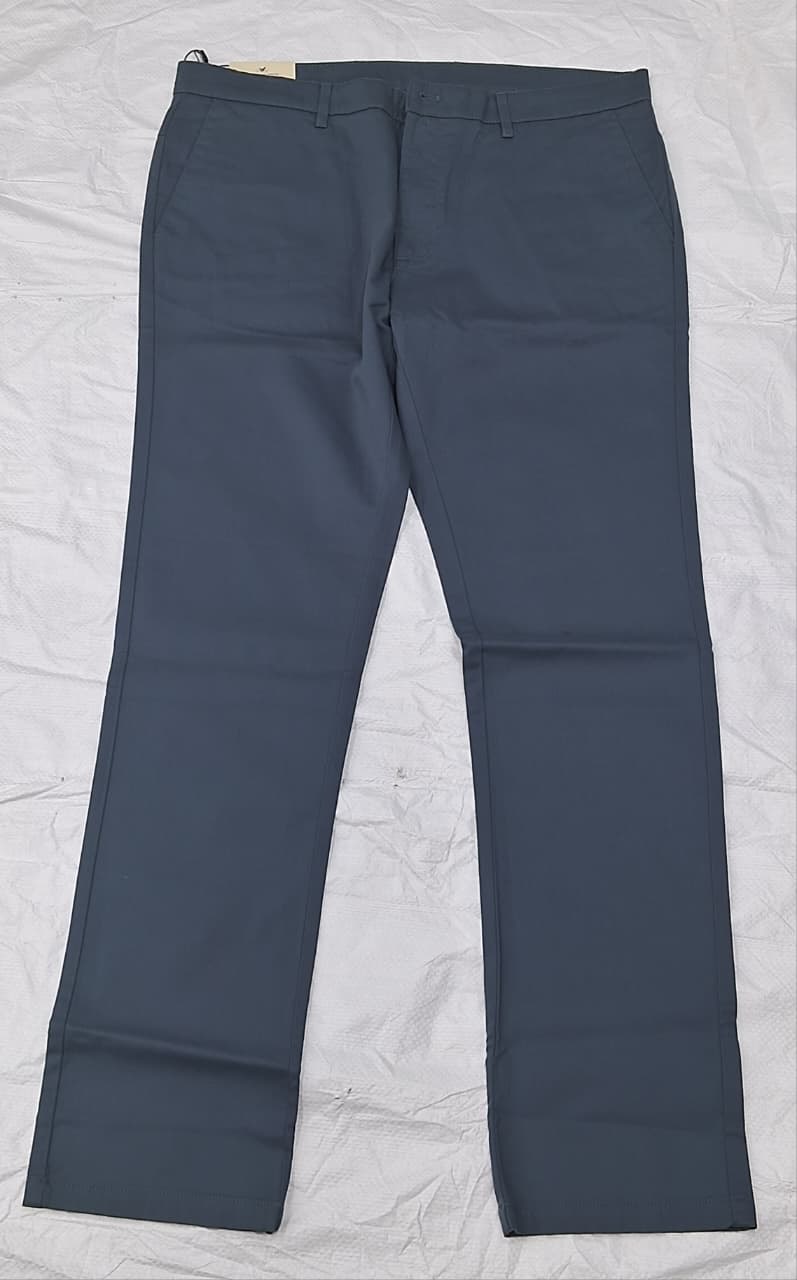
Blue men's formal trousers laid flat showing clean, defined lines
J-07 — Blue: defined edges and a clean crease suggest a firmer drape.

Matching drape to cut

Slim and tailored trousers usually benefit from firmer drape, which keeps their narrow lines neat. Pleated and relaxed trousers benefit from more fluid drape, which lets their extra cloth move elegantly rather than stand out stiffly. A pleated trouser in a stiff-looking cloth can look boxy; a very slim trouser in a very fluid cloth can cling.

Drape and occasion

Crisper, firmer-looking trousers read as sharper and more formal. Softer, more fluid ones read as relaxed and comfortable. Use that to fine-tune an outfit: the same grey trouser in a crisp cloth suits a presentation; in a soft, textured cloth it suits a relaxed lunch.

Five pairs, chosen in the right order, can cover almost every professional and social situation.

1 · Charcoal or mid grey

Start with the most versatile colour. A tailored charcoal or mid-grey trouser works with navy, black, grey and brown jackets, with every shirt colour, and with both black and brown shoes. It is formal enough for important meetings and neutral enough for daily wear.

2 · Navy

Navy brings warmth and pairs with grey, beige and camel jackets. With brown shoes it creates one of the most reliable combinations in menswear.

3 · Beige or stone

A lighter, warmer trouser for smart casual days and warm weather. Beige relaxes navy blazers and works with white, blue and pastel shirts.

4 · Black

For formal occasions and evening events. Black is less flexible by day, but essential when the dress code is strict.

5 · A character piece

Once the essentials are in place, add personality: brown, olive, cream, a subtle check or a textured surface. This is the trouser that makes a familiar wardrobe feel new.

Silhouette across the wardrobe

Keep the core pairs in a consistent silhouette that suits your build — usually tailored — so that they all work with the same jackets and shoes. Use the character piece to experiment with a different cut, such as pleats or a straighter leg.

09StylingApprox. 4 min read

Coordinating formal pants with shirts

Shirt and trouser are the two halves of every outfit. Their relationship is built on contrast, colour and the line where they meet.

Start with contrast

The most reliable principle is contrast in depth. A light shirt above dark trousers — white over charcoal, light blue over navy — gives a crisp waistline and a confident, formal look. A darker shirt above lighter trousers — navy over beige, olive over cream — reads more relaxed. Shirt and trousers of very similar depth can look flat unless the textures are clearly different.

Then choose colour

  • White works with every formal trouser colour.
  • Light blue works with grey, navy, charcoal, beige and brown.
  • Pink and lilac flatter grey, charcoal and navy.
  • Cream and ecru warm up brown, olive and navy.
  • Dark shirts such as navy or black suit light trousers in relaxed settings.

Mind the meeting point

Formal shirts are designed to be tucked, and formal trousers are designed to receive them. The waistband should hold the shirt smoothly; a belt that matches the shoes completes the line. Avoid a shirt so long or loose that it balloons above the waistband — it shortens the leg visually.

Pattern

Patterned shirts — stripes, small checks — sit best with plain trousers. If the trousers are patterned, keep the shirt plain. One pattern per pairing is a rule worth keeping.

10ContextApprox. 4 min read

Modern professional dressing

Dress codes have relaxed, but expectations have not disappeared. They have simply moved from the suit to the details.

From suits to separates

In many workplaces the daily suit has given way to separates: formal trousers worn with a contrasting blazer, a shirt without a tie, or knitwear. This makes men's formal trousers the foundation of professional dress — the garment that holds the outfit to a professional standard while everything else relaxes.

What still matters

In a relaxed dress code, fit and finish carry more weight than ever. A well-fitted, pressed trouser signals care in a way that a tie no longer needs to. Length, crease and clean shoes are noticed precisely because the rest of the outfit is simpler.

Reading the room

  • Traditional settings — charcoal or navy, tailored or classic fit, matching jacket.
  • Modern offices — grey or navy trousers with a contrasting blazer.
  • Creative workplaces — olive, brown or textured trousers with knitwear.
  • Client-facing days — return to the darker, more formal end of the palette.

The professional constant

Whatever the dress code, the formal trouser's role is the same: to provide a clean, well-proportioned base. When it does that job well, the rest of the outfit can be as formal or as relaxed as the day requires.

11ProportionApprox. 3 min read

Understanding trouser breaks

The break is the small fold where the trouser meets the shoe. It is a few centimetres of cloth that sets the tone of the entire outfit.

No break

The hem just touches the top of the shoe without folding. It looks sharp, modern and deliberate, and suits slim and tapered trousers, loafers and smart casual outfits. It demands precise length.

Slight break

The hem rests on the shoe with a barely visible fold at the front. This is the most versatile break — contemporary but not extreme — and works for most office and business trousers.

Half break

A single, clearly visible fold. It looks classic and composed, and suits straight and regular legs and more traditional business dress.

Full break

A deep fold, sometimes two, with the hem covering much of the shoe. Traditionally associated with fuller trousers and formal tailoring, it looks generous and can shorten the leg if overdone.

Choosing yours

Match the break to the leg opening: the narrower the opening, the smaller the break it can carry. Then match it to the occasion and the shoe. Above all, choose it — a break should never be an accident of length.

Four drawings of a trouser hem meeting a shoe: no break, slight break, half break and full break NO BREAKSLIGHTHALFFULL
J-11 — From left: no break, slight, half and full. Teal marks the fold.

× Hem detail from J-05

12MovementApprox. 4 min read

The relationship between fit and movement

A trouser is fitted standing still and worn in motion. The best fit is the one that survives the journey between the two.

Most fitting happens in front of a mirror, standing upright. But formal trousers spend much of the day walking, sitting, climbing and turning — and each movement makes different demands on the cut.

Walking

Each stride stretches the trouser over the front thigh and gathers it behind the back knee. Enough room through the seat and thigh lets the fabric release without pulling across the front. A trouser that is too slim will show tension lines with every step.

Diagram of a trouser in mid-stride showing where fabric stretches, folds and settles STRETCHFOLDHEM SETTLES
J-12 — In stride: the front leg stretches, the back knee folds.

Sitting

Sitting is the hardest test. The seat and thigh take the strain, the rise determines whether the waistband stays in place at the back, and the hem lifts to reveal more of the shin. A trouser with a sensible rise, comfortable seat and a little extra length handles sitting gracefully.

Standing and recovering

After movement, a well-fitted trouser recovers. The crease returns to centre, the hem settles back onto the shoe and the seat smooths out. Fabric plays a part — some cloths recover more readily than others — but fit is the foundation.

The lesson

When trying on formal pants, do more than stand. Walk, sit, climb a step and reach for something. The fit that looks best in motion is the fit that will look best all day.

End of volume one

Read, then try on

These essays are meant to be used. Read the ones that answer your current question, then take what you have learned into the fitting room — or into your own wardrobe.

About Options Mall